Purchase And Acquire Your Medication On The Web. On-line Pharmacy Store. Get Cost-free Drugs. Everybody Would Love To Obtain Cheaped In Drug Shop At Residence Beneath webpage By Natural Means. And Get The Very Best Provides For yasmin. You Can Do It Also If You Don`t Have A Doctor’s Prescription.

The paper Visual Synonyms for Landmark Image Retrieval by Efstratios Gavves, Cees Snoek and Arnold Smeulders, which is to appear in Computer Vision and Image Understanding is now available. In this paper, we address the incoherence problem of the visual words in bag-of-words vocabularies. Different from existing work, which assigns words based on closeness in descriptor space, we focus on identifying pairs of independent, distant words – the visual synonyms – that are likely to host image patches of similar visual reality. We focus on landmark images, where the image geometry guides the detection of synonym pairs. Image geometry is used to find those image features that lie in the nearly identical physical location, yet are assigned to different words of the visual vocabulary. Defined in this way, we evaluate the validity of visual synonyms. We also examine the closeness of synonyms in the L2-normalized feature space. We show that visual synonyms may successfully be used for vocabulary reduction. Furthermore, we show that combining the reduced visual vocabularies with synonym augmentation, we perform on par with the state-of-the-art bag-of-words approach, while having a 98% smaller vocabulary.

The paper Personalizing Automated Image Annotation using Cross-Entropy was presented today by Xirong Li et al.  at ACM Multimedia 2011. In this paper it is observed that annotating the increasing amounts of user-contributed images in a personalized manner is in great demand. However, this demand is largely ignored by the mainstream of automated image annotation research. In this paper we aim for personalizing automated image annotation by jointly exploiting personalized tag statistics and content-based image annotation. We propose a cross-entropy based learning algorithm which personalizes a generic annotation model by learning from a user’s multimedia tagging history. Using cross-entropy-minimization basedMonte Carlo sampling, the proposed algorithm optimizes the personalization process in terms of a performance measurement which can be flexibly chosen. Automatic image annotation experiments with 5,315 realistic users in the social web show that the proposed method compares favorably to a generic image annotation method and a method using personalized tag statistics only. For 4,442 users the performance improves, where for 1,088 users the absolute performance gain is at least 0.05 in terms of average precision. The results show the value of the proposed method.

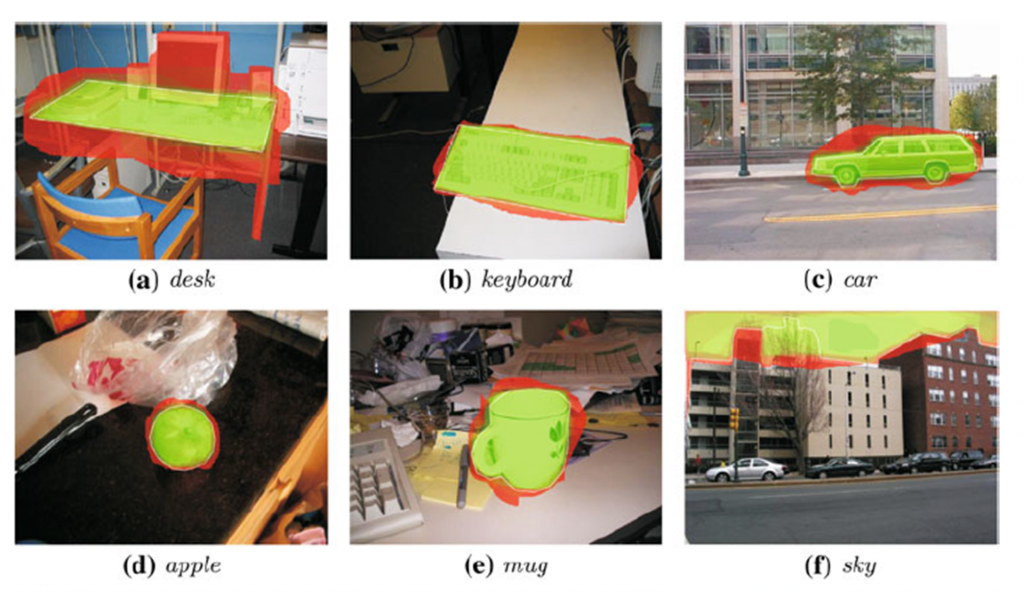
The master thesis by Jeroen Steggink entitled Adding Semantics to Image-Region Annotations with the Name-It-Game is now published in the special issue of Multimedia Systems journal on Interactive multimedia computing. In this paper we present the Name-It-Game, an interactive multimedia game fostering the swift creation of a large data set of region-based image annotations. Compared to existing annotation games, we consider an added semantic structure, by means of the WordNet ontology, the main innovation of the Name-It-Game. Using an ontology-powered game, instead of the more traditional annotation tools, potentially makes region-based image labeling more fun and accessible for every type of user. However, the current games often present the players with hard-to-guess objects. To prevent this from happening in the Name-It-Game, we successfully identify WordNet categories which filter out hard-to-guess objects. To verify the speed of the annotation process, we compare the online Name-It-Game with a desktop tool with similar features. Results show that the Name-It-Game outperforms this tool for semantic region-based image labeling. Lastly, we measure the accuracy of the produced segmentations and compare them with carefully created LabelMe segmentations. Judging from the quantitative and qualitative results, we believe the segmentations are competitive to those of LabelMe, especially when averaged over multiple games. By adding semantics to region-based image annotations, using the Name-It-Game, we have opened up an efficient means to provide precious labels in a playful manner.

The paper Crowdsourcing Visual Detectors for Video Search by Bauke Freiburg, Jaap Kamps, and Cees Snoek, which will appear in the forthcoming ACM Multimedia conference is now available. In this paper, we study social tagging at the video fragment-level using a combination of automated content understanding and the wisdom of the crowds. We are interested in the question whether crowdsourcing can be beneficial to a video search engine that automatically recognizes video fragments on a semantic level. To answer this question, we perform a 3-month online field study with a concert video search engine targeted at a dedicated user-community of pop concert enthusiasts. We harvest the feedback of more than 500 active users and perform two experiments. In experiment 1 we measure user incentive to provide feedback, in experiment 2 we determine the tradeoff between feedback quality and quantity when aggregated over multiple users. Results show that users provide sufficient feedback, which becomes highly reliable when a crowd agreement of 67% is enforced.

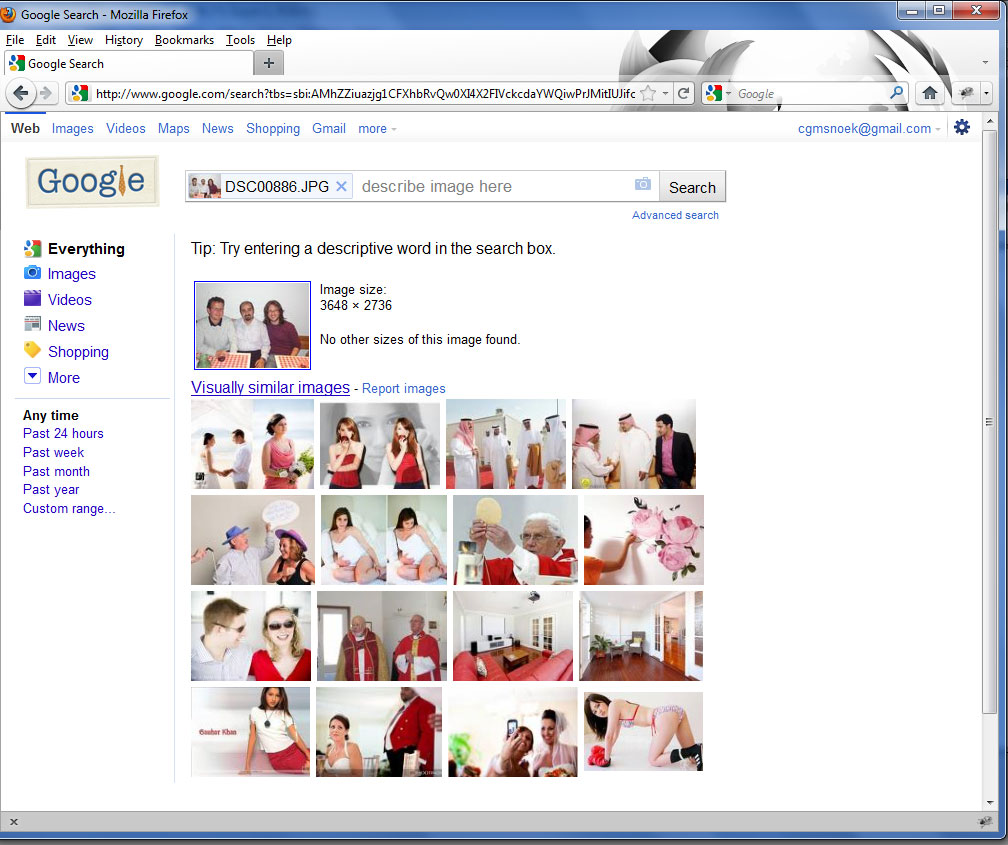
Google recently introduced query-by-example in their image search engine. Query-by-example allows users to drag an image from their desktop into the search input field and after hitting the “search” button a bunch of matching images is returned. I consider it a positive sign that visual retrieval methods from the academic literature are finally finding their way to real-world deployment at Google scale. For those interested, the first version of query-by-example was described in 1992 in a paper by Kato et al. and was made popular by IBM’s QBIC. See their demo at the website of the Hermitage. Query-by-example can be fruitful when users search for the same object under slightly varying circumstances and when the target images are available indeed.If proper example images are unavailable, query-by-example is not effective at all. Moreover, users often do not understand similarity of the low-level visual features used for recognition. They expect semantic similarity. I tried a search using a recent photo of me, Masoud and Stratis. Judging from the results I believe there is still plenty of research left to do before query-by-example is solved.

The paper Social Negative Bootstrapping for Visual Categorization was presented by Xirong Li at ACM’s International Conference on Multimedia Retrieval and is now available for download. To learn classifiers for many visual categories, obtaining labeled training examples in an efficient way is crucial. Since a classifier tends to misclassify negative examples which are visually similar to positive examples, inclusion of such informative negatives should be stressed in the learning process. However, they are unlikely to be hit by random sampling, the de facto standard in literature. In this paper, we go beyond random sampling by introducing a novel social negative bootstrapping approach. Given a visual category and a few positive examples, the proposed approach adaptively and iteratively harvests informative negatives from a large amount of social-tagged images. To label negative examples without human interaction, we design an effective virtual labeling procedure based on simple tag reasoning. Virtual labeling, in combination with adaptive sampling, enables us to select the most misclassified negatives as the informative samples. Learning from the positive set and the informative negative sets results in visual classifiers with higher accuracy. Experiments on two present-day image benchmarks employing 650K virtually labeled negative examples show the viability of the proposed approach. On a popular visual categorization benchmark our precision at 20 increases by 34%, compared to baselines trained on randomly sampled negatives. We achieve more accurate visual categorization without the need of manually labeling any negatives.

Empowering Visual Categorization with the GPU

The paper “Empowering Visual Categorization with the GPU” by Koen E. A. van de Sande, Theo Gevers, and Cees G. M. Snoek is now officially published in IEEE Transactions on Multimedia. In this paper, we analyze the bag-of-words model for visual categorization, the most powerful method in the literature, in terms of computational cost and identify two major bottlenecks: the quantization step and the classification step. We address these two bottlenecks by proposing two efficient algorithms for quantization and classification by exploiting the GPU hardware and the CUDA parallel programming model. The algorithms are designed to 1) keep categorization accuracy intact, 2) decompose the problem, and 3) give the same numerical results. In the experiments on large scale datasets, it is shown that, by using a parallel implementation on the Geforce GTX260GPU, classifying unseen images is 4.8 times faster than a quad-core CPU version on the Core i7 920, while giving the exact same numerical results. In addition, we show how the algorithms can be generalized to other applications, such as text retrieval and video retrieval. Moreover, when the obtained speedup is used to process extra video frames in a video retrieval benchmark, the accuracy of visual categorization is improved by 29%.

synonym_explanation

The forthcoming ACM Multimedia 2010 paper on Landmark Image Retrieval Using Visual Synonyms by Efstratios Gavves and Cees Snoek is now available. In this paper, we consider the incoherence problem of the visual words in bag-of-words vocabularies. Different from existing work, which performs assignment of words based solely on closeness in descriptor space, we focus on identifying pairs of independent, distant words – the visual synonyms – that are still likely to host image patches with similar appearance. To study this problem, we focus on landmark images, where we can examine whether image geometry is an appropriate vehicle for detecting visual synonyms. We propose an algorithm for the extraction of visual synonyms in landmark images. To show the merit of visual synonyms, we perform two experiments. We examine closeness of synonyms in descriptor space and we show a first application of visual synonyms in a landmark image retrieval setting. Using visual synonyms, we perform on par with the state-of-the-art, but with six times less visual words.

And another ACM Multimedia 2010 paper titled: Crowdsourcing Rock N’ Roll Multimedia Retrieval by Cees Snoek, Bauke Freiburg, Johan Oomen, and Roeland Ordelman is also available online.

Crowdsourcing music video

In this technical demonstration, we showcase a multimedia search engine that facilitates semantic access to archival rock n’ roll concert video. The key novelty is the crowdsourcing mechanism, which relies on online users to improve, extend, and share, automatically detected results in video fragments using an advanced timeline-based video player. The user-feedback serves as valuable input to further improve automated multimedia retrieval results, such as automatically detected concepts and automatically transcribed interviews. The search engine has been operational online to harvest valuable feedback from rock n’ roll enthusiasts.

The ACM Multimedia 2010 paper entitled Keep Moving! Revisiting Thumbnails for Mobile Video Retrieval by Wolfgang Hürst, Cees G. M. Snoek, Willem-Jan Spoel, and Mate Tomin is available online.

Motivated by the increasing popularity of video on handheld devices and the resulting importance for effective video retrieval, this paper revisits the relevance of thumbnails in a mobile video retrieval setting. In particular, we quantified the usage of static and dynamic thumbnails for interactive video retrieval on a handheld device. Contrary to widespread believe that screens of handheld devices are unsuited for visualizing multiple (small) thumbnails simultaneously, our results suggest that users are quite able to handle and assess multiple thumbnails, especially when they are showing moving images. This result suggests promising avenues for future research with respect to the design and interaction with advanced video retrieval interfaces on mobile devices. Although the limited screen estate of handheld devices allows for less advanced video retrieval interfaces than those common for the desktop, they can be still much more complex that one would assume, especially when they rely on moving images. Therefore, when designing mobile video retrieval interfaces we recommend keep moving!