

Foto: Hilde de Wolf Fotografie.
Foto: Hilde de Wolf Fotografie.

Dr Cees Snoek of the University of Amsterdam (UvA) has won the Netherlands Prize for ICT research 2012. The prizewinner also receives €50,000. Computer scientist Snoek leads a research team working on the development of a smart search engine for digital video: the Media Mill Semantic Video Search Engine.
The Netherlands Prize for ICT research was established for scientists under 40, who are conducting innovative research or are responsible for a scientific breakthrough in the field of ICT. The award is an initiative of the ICT Research Platform Netherlands (IPN) and the Netherlands Organisation for Scientific Research’s (NWO) Physical Sciences division in cooperation with the Royal Holland Society of Sciences (KHMW).

The paper “Content-Based Analysis Improves Audiovisual Archive Retrieval” by Bouke Huurnink, Cees Snoek, Maarten de Rijke, and Arnold Smeulders, which appears in the August issue of IEEE Transactions on Multimedia, is now available. Content-based video retrieval is maturing to the point where it can be used in real-world retrieval practices. One such practice is the audiovisual archive, whose users increasingly require fine-grained access to broadcast television content. In this paper, we take into account the information needs and retrieval data already present in the audiovisual archive, and demonstrate that retrieval performance can be significantly improved when content-based methods are applied to search. To the best of our knowledge, this is the first time that the practice of an audiovisual archive has been taken into account for quantitative retrieval evaluation. To arrive at our main result, we propose an evaluation methodology tailored to the specific needs and circumstances of the audiovisual archive, which are typically missed by existing evaluation initiatives. We utilize logged searches, content purchases, session information, and simulators to create realistic query sets and relevance judgments. To reflect the retrieval practice of both the archive and the video retrieval community as closely as possible, our experiments with three video search engines incorporate archive-created catalog entries as well as state-of-the-art multimedia content analysis results. A detailed query-level analysis indicates that individual content-based retrieval methods such as transcript-based retrieval and concept-based retrieval yield approximately equal performance gains. When combined, we find that content-based video retrieval incorporated into the archive’s practice results in significant performance increases for shot retrieval and for retrieving entire television programs. The time has come for audiovisual archives to start accommodating content-based video retrieval methods into their daily practice.

The paper “Harvesting Social Images for Bi-Concept Search” by Xirong Li, Cees Snoek, Marcel Worring and Arnold Smeulders, which appears in the August issue of IEEE Transactions on Multimedia, is now available. Searching for the co-occurrence of two visual concepts in unlabeled images is an important step towards answering complex user queries. Traditional visual search methods use combinations of the confidence scores of individual concept detectors to tackle such queries. In this paper we introduce the notion of bi-concepts, a new concept-based retrieval method that is directly learned from social-tagged images. As the number of potential bi-concepts is gigantic, manually collecting training examples is infeasible. Instead, we propose a multimedia framework to collect de-noised positive as well as informative negative training examples from the social web, to learn bi-concept detectors from these examples, and to apply them in a search engine for retrieving bi-concepts in unlabeled images. We study the behavior of our bi-concept search engine using 1.2M social-tagged images as a data source. Our experiments indicate that harvesting examples for bi-concepts differs from traditional single-concept methods, yet the examples can be collected with high accuracy using a multi-modal approach. We find that directly learning bi-concepts is better than oracle linear fusion of single-concept detectors, with a relative improvement of 100\%. This study reveals the potential of learning high-order semantics from social images, for free, suggesting promising new lines of research.
Médicaments Sur Ordonnance Au Canada. Expédition Rapide Par Courrier Ou Par Avion. Pharmacie Canadienne Officielle. Aucune Prescription Requise. Vous Pourriez Obtenir Rapidement Des Réductions Auprès De La Pharmacie De Quartier De Nice De La Résidence Proprement Dite learn the facts here now. Vous N’aurez Pas Besoin D’aller Chez Le Médecin Pour Obtenir Une Ordonnance. Prix idéaux Pour Les Commandes Suivantes.
Congratulations to Xirong Li for being awarded the 2012 IEEE Transactions on Multimedia Prize Paper Award. Li received the prize for the publication “Learning Social Tag Relevance by Neighbor Voting”. The Multimedia Prize Paper Award is an annual award for an original paper in the field of multimedia published in the IEEE Transactions on Multimedia in the previous three calendar years. The paper of Xirong Li was selected out of 14 nominations. The basis for judging is the composite of: originality, utility, timeliness, and clarity of presentation.
In a world where the amount of digital images is ever-growing, it is important to to be able to search based on the visual content. Xirong Li was inspired by social media and investigated the value of images with social tags for visual search. He developed an algorithm that automatically determines whether the tag people assign to a photo matches what is actually visible in the image. Moreover, the paper provides a formal analysis on the proposed algorithm, theoretically showing its effectiveness for both image ranking and tag ranking.
Xirong Li, Cees G. M. Snoek, and Marcel Worring, “Learning Social Tag Relevance by Neighbor Voting,” IEEE Transactions on Multimedia, vol. 11, iss. 7, pp. 1310-1322, 2009.

The Chinese Government Award for Outstanding Self-financed Students Abroad was awarded to Xirong Li.
The PhD thesis of Xirong, entitled ‘Content-Based Visual Search Learned from Social Media’, reveals the value of socially tagged images for content-based visual search. To learn from social media, Xirong proposed algorithms which automatically determine whether a tag spontaneously assigned to a picture is factually relevant with respect to the visual content. By identifying relevant tags, he has found a way to transfer noisy social data into numerous well-labelled examples. This leads to an intelligent search engine which can find unlabelled images on the Internet, a smart phone, or a laptop. The increasing availability of labelled examples also enables the search engine to answer more complex queries, e.g., finding images of horse riders on the beach. Xirong’s work opens up promising avenues for search engines that provide access to the semantics of unlabelled images, without the need for expert labelling. Xirong successfully defended his thesis on 9 March 2012 and is currently an Assistant Professor at Renmin University of China.
The Chinese Government Award for Outstanding Self-financed Students Abroad was founded by the Chinese government in 2003 with the purpose of rewarding academic excellence among self-financed Chinese students studying overseas. Only those with outstanding performance in their PhD studies are considered by the award selection committee. Each year, approximately 500 young Chinese talents worldwide are granted the award.

The ICMR2012 paper Fusing Concept Detection and Geo Context for Visual Search by Xirong Li, Cees Snoek, Marcel Worring and Arnold Smeulders is now available. Given the proliferation of geo-tagged images, the question of how to exploit geo tags and the underlying geo context for visual search is emerging. Based on the observation that the importance of geo context varies over concepts, we propose a concept-based image search engine which fuses visual concept detection and geo context in a concept-dependent manner. Compared to individual content-based and geo-based concept detectors and their uniform combination, concept-dependent fusion shows improvements. Moreover, since the proposed search engine is trained on social-tagged images alone without the need of human interaction, it is flexible to cope with many concepts. Search experiments on 101 popular visual concepts justify the viability of the proposed solution. In particular, for 79 out of the 101 concepts, the learned weights yield improvements over the uniform weights, with a relative gain of at least 5% in terms of average precision.
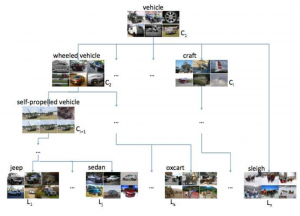
The forthcoming paper All Vehicles are Cars: Subclass Preferences in Container Concepts by Daan Vreeswijk, Koen van de Sande, Cees Snoek and Arnold Smeulders is now available. This paper investigates the natural bias humans display when labeling images with a container label like vehicle or carnivore. Using three container concepts as subtree root nodes, and all available concepts between these roots and the images from the ImageNet Large Scale Visual Recognition Challenge (ILSVRC) dataset, we analyze the differences between the images labeled at these varying levels of abstraction and the union of their constituting leaf nodes. We find that for many container concepts, a strong preference for one or a few different constituting leaf nodes occurs. These results indicate that care is needed when using hierarchical knowledge in image classification: if the aim is to classify vehicles the way humans do, then cars and buses may be the only correct results. The paper will be presented at ICMR2012 in Hong Kong on June 6.
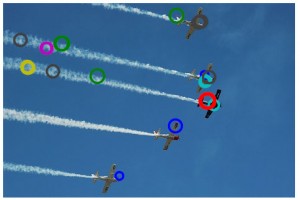
The forthcoming CVPR paper on Convex Reduction of High-Dimensional Kernels for Visual Classification by Efstratios Gavves, Cees Snoek and Arnold Smeulders is now available. Limiting factors of fast and effective classifiers for large sets of images are their dependence on the number of images analyzed and the dimensionality of the image representation. Considering the growing number of images as a given, we aim to reduce the image feature dimensionality in this paper. We propose reduced linear kernels that use only a portion of the dimensions to reconstruct a linear kernel. We formulate the search for these dimensions as a convex optimization problem, which can be solved efficiently. Different from existing kernel reduction methods, our reduced kernels are faster and maintain the accuracy benefits from non-linear embedding methods that mimic non-linear SVMs. We show these properties on both the Scenes and PASCAL VOC 2007 datasets. In addition, we demonstrate how our reduced kernels allow to compress Fisher vector for use with non-linear embeddings, leading to high accuracy. What is more, without using any labeled examples the selected and weighed kernel dimensions appear to correspond to visually meaningful patches in the images.
We are organizing a special session on Socio-Video Semantics at the forthcoming ACM International Conference on Multimedia Retrieval in Hong Kong.
Aims and Scope
All of a sudden video became social. In just five years, individual and mostly inactive consumers transformed into active and connected prosumers, revolutionaries even, who create, share, and comment on massive amounts of video artifacts all over the world wide web 2.0. Pronounced manifestations of social video on the Internet include industry initiatives like YouTube, Vimeo, WikiPedia, and Flickr, who manage to attract millions of users, daily. It has been predicted that soon 91 percent of Internet data will be video, where smartphones will only accelerate the unstoppable momentum. In order to make sense of the massive amounts of video content, online social platforms rely on what other people say is in the image, which is known to be ambiguous, overly personalized, and limited. Hence, the lack of semantics currently associated with online video is seriously hampering retrieval, repurposing, and usage. In contrast to social video platforms, academic video sensemaking approaches rely on an analysis of the multimedia content. Such content-driven image search is important, if only to verify what people have said is factually in the video, or for (professional) archives which cannot be shared for crowdsourcing. Despite good progress, automated multimedia analysis of video content is still seriously hampered by the semantic gap, or the lack of correspondence between the low-level audiovisual features that machines extract from video and the high-level conceptual interpretations a human gives to multimedia data. For sensemaking, exploiting the social multimedia context of video has largely been ignored in the multimedia community. This special session provides a unique opportunity for high-quality papers connecting the social context of online video to video sensemaking.
Topics of Interest
Topics of interest include (but are not limited to):
Socio-video content analysis
Socio-video browsing and retrieval
Socio-video benchmark construction and open-source software
Paper Submission
All papers must be formatted according to the ACM conference style, cannot exceed 8 pages in 9 point font, and must be submitted as pdf files.
ACM ICMR 2012 follows double-blind review. Please make sure that the names and affiliations of the authors are excluded in the document. Also remember to avoid information that may identify the authors.
Either the Microsoft Word or LaTex can be used to prepare the manuscripts (but final submission file should be in pdf format). The paper templates can be downloaded directly from the ACM ICMR 2012 website:
http://www.icmr2012.org/submission.html
Selected manuscripts will also be invited for a special issue in IEEE Transactions on Multimedia on the same topic.
Important Dates
— Paper submission deadline: January 15, 2012
— Notification of acceptance: March 15, 2012
— Camera-ready manuscript: April 5, 2012
Organizers
Cees G. M. Snoek, University of Amsterdam (Netherlands)
Yu-Gang Jiang, Fudan University (China)
