Bassi Costi. In Farmacia Online Se Non Hai La Prescrizione Del Medico. Tariffe Più Convenienti. Ogni Persona Vorrebbe Scoprire Fondamentalmente A Basso Costo All’interno Del Rivenditore Di Farmaci In Italia Senza Prescrizione Su Questo Sito http://www.amptavolara.com/costo-micardis-40mg/. Con Un Fantastico Sconto. Ottieni Rapidamente Spedizione E Consegna Se Hai Pagato Con Carta Di Credito.
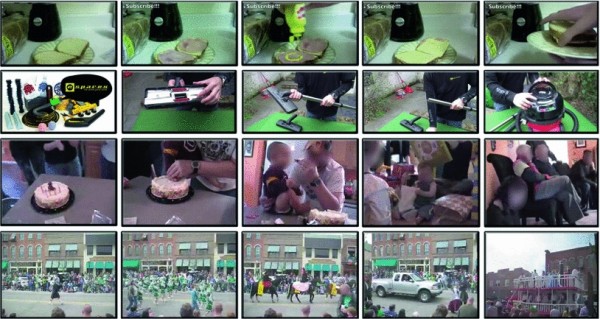
The paper “Evaluating Multimedia Features and Fusion for Example-based Event Detection” by the SESAME project consortium, which will appear in a forthcoming issue of Machine Vision and Applications is now available. In this paper we consider the problem of detecting events in Internet video, like the ones depicted: making a sandwich, repairing an appliance, birthday party, and parade. Multimedia event detection (MED)is a challenging problem because of the heterogeneous content and variable quality found in large collections of Internet videos. To study the value of multimedia features and fusion for representing and learning events from a set of example video clips, we created SESAME, a system for video SEarch with Speed and Accuracy for Multimedia Events. SESAME includes multiple bag-of-words event classifiers based on single data types: low-level visual, motion, and audio features; high-level semantic visual concepts; and automatic speech recognition. Event detection performance was evaluated for each event classifier. The performance of low-level visual and motion features was improved by the use of difference coding. The accuracy of the visual concepts was nearly as strong as that of the low-level visual features. Experiments with a number of fusion methods for combining the event detection scores from these classifiers revealed that simple fusion methods, such as arithmetic mean, perform as well as or better than other, more complex fusion methods. SESAME’s performance in the 2012 TRECVID MED evaluation was one of the best reported.
event-examples

xirong

Congratulations to dr. Xirong Li for receiving the SIGMM Award for Outstanding PhD Thesis in Multimedia Computing, Communications and Applications 2013. The committee considered Xirong’s dissertation titled “Content-based visual search learned from social media” as worthy of the award as it substantially extends the boundaries for developing content-based multimedia indexing and retrieval solutions. In particular, it provides fresh new insights into the possibilities for realizing image retrieval solutions in the presence of vast information that can be drawn from the social media.

The committee considered the main innovation of Xirong’s work to be in the development of the theory and algorithms providing answers to the following challenging research questions:
(a) what determines the relevance of a social tag with respect to an image,
(b) how to fuse tag relevance estimators,
(c) which social images are the informative negative examples for concept learning,
(d) how to exploit socially tagged images for visual search and
(e) how to personalize automatic image tagging with respect to a user’s preferences.

The significance of the developed theory and algorithms lies in their power to enable effective and efficient deployment of the information collected from the social media to enhance the datasets that can be used to learn automatic image indexing mechanisms (visual concept detection) and to make this learning more personalized for the user.

Xirong’s thesis is available from the UvA digital academic repository.

icmr2014

Todos podem comprar drogas de próstata aumentadas de tamanho confiável na farmácia local em Charlotte pelo telefone aqui Cialis sem reservas! Você não precisará visitar o médico e obter uma receita. Negócio maravilhoso, peguei algumas coisas de marca e várias embalagens do medicamento genérico. O excesso de peso ou OBESIDADE, um excesso de peso pode afetar uma pessoa, o risco de desenvolver alguns problemas de saúde Como a disfunção erétil Abuso de drogas – a maioria das drogas (especialmente usados ​​para tratar a pressão arterial alta, depressão e ansiedade e drogas) pode causar a disfunção erétil este.
[Application for the vacancy below was possible until July 31, 2013.]

We have a vacancy for a PhD student at the University of Amsterdam. The topic of the PhD is to recognize objects in a visual data stream. In such a stream the object classes of interest shift over time. Hence, the traditional approach to learn classifiers for a predefined set of objects is unsuited. A promising approach in classifying unseen objects into a novel category is to learn a semantic attribute image representation. The aim for this PhD is to develop new algorithms to learn such a high-level semantic representation from weakly annotated images and to learn the mapping to an unknown class from freely available (textual) sources. Another project aim is to model the visual data stream to understand which images or novel concepts could become a visual trend.

More information, requirements, appointment and application via this website.

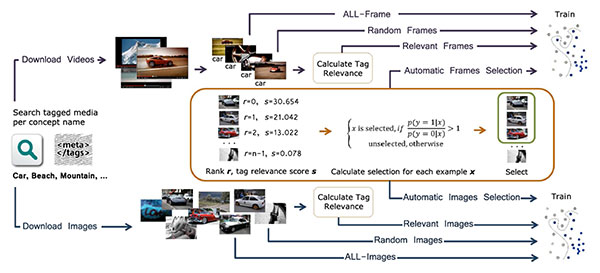
The CBMI’13 paper “Evaluating Sources and Strategies for Learning Video Concepts from Social Media” by Svetlana Kordumova, Xirong Li and Cees Snoek is now available. Learning video concept detectors from social media sources, such as Flickr images and YouTube videos, has the potential to address a wide variety of concept queries for video search. While the potential has been recognized by many, and progress on the topic has been impressive, we argue that two key questions, i.e., What visual tagging source is most suited for selecting positive training examples to learn video concepts? and What strategy should be used for selecting positive examples from tagged sources?, remain open. As an initial attempt to answer the two questions, we conduct an experimental study using a video search engine which is capable of learning concept detectors from social media, be it socially tagged videos or socially tagged images.Within the video search engine we investigate six strategies of positive examples selection. The performance is evaluated on the challenging TRECVID benchmark 2011 with 400 hours of Internet videos. The new experiments lead to novel and nontrivial findings: (1) tagged images are a better source for learning video concepts from the web, (2) selecting tag relevant examples as positives for learning video concepts is always beneficial and it can be done automatically and (3) the best source and strategy compare favorably against several present-day methods.

sources-strategies

negative-bootstrap

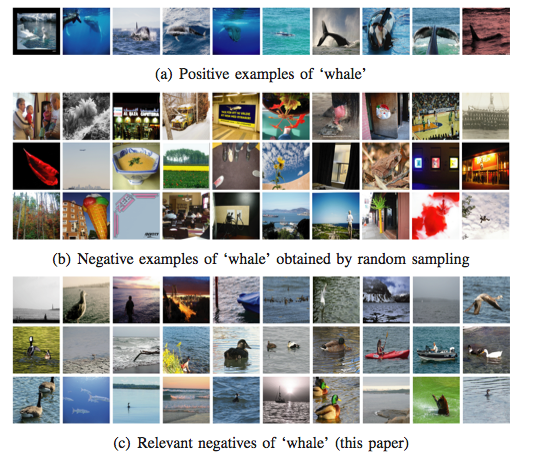
The paper “Bootstrapping Visual Categorization With Relevant Negatives” by Xirong Li, Cees Snoek, Marcel Worring, Dennis Koelma, and Arnold Smeulders appears in the current issue of IEEE Transaction on Multimedia. Learning classifiers for many visual concepts are important for image categorization and retrieval. As a classifier tends to misclassify negative examples which are visually similar to positive ones, inclusion of such misclassified and thus relevant negatives should be stressed during learning. User-tagged images are abundant online, but which images are the relevant negatives remains unclear. Sampling negatives at random is the de facto standard in the literature. In this paper, we go beyond random sampling by proposing Negative Bootstrap. Given a visual concept and a few positive examples, the new algorithm iteratively finds relevant negatives. Per iteration, we learn from a small proportion of many user-tagged images, yielding an ensemble of meta classifiers. For efficient classification, we introduce Model Compression such that the classification time is independent of the ensemble size. Compared with the state of the art, we obtain relative gains of 14% and 18% on two present-day benchmarks in terms of mean average precision. For concept search in one million images, model compression reduces the search time from over 20 h to approximately 6 min. The effectiveness and efficiency, without the need of manually labeling any negatives, make negative bootstrap appealing for learning better visual concept classifiers.

better-or-more-noisy-concepts

The ICMR2013 paper ‘Recommendations for Video Event Recognition Using Concept Vocabularies’ by Amirhossein Habibian, Koen van de Sande and Cees Snoek is now available. Representing videos using vocabularies composed of concept detectors appears promising for event recognition. While many have recently shown the benefits of concept vocabularies for recognition, the important question what concepts to include in the vocabulary is ignored. In this paper, we study how to create an effective vocabulary for arbitrary event recognition in web video. We consider four research questions related to the number, the type, the specificity and the quality of the detectors in concept vocabularies. A rigorous experimental protocol using a pool of 1,346 concept detectors trained on publicly available annotations, a dataset containing 13,274 web videos from the Multimedia Event Detection benchmark, 25 event groundtruth definitions, and a state-of-the-art event recognition pipeline allow us to analyze the performance of various concept vocabulary definitions. From the analysis we arrive at the recommendation that for effective event recognition the concept vocabulary should i) contain more than 200 concepts, ii) be diverse by covering object, action, scene, people, animal and attribute concepts, iii) include both general and specific concepts, and iv) increase the number of concepts rather than improve the quality of the individual detectors. We consider the recommendations for video event recognition using concept vocabularies the most important contribution of the paper, as they provide guidelines for future work.

Any Visitor needs to purchase real drugs to prevent streptococcal infection in Omaha pharmacy from property right right here Ampicillin rapidly. And get the ideal delivers for medications to prevent streptococcal infection. Acquire Low cost Medication On the internet With no Prescription. austrmed.com Together they set the liver a heavy burden, which is why the liver commences to perform much more intensively This not only has an effect on the liver negatively, but also the therapeutic impact of the preparing is impaired Ampicillin for young children The antibiotic can.
informative-concept-bank
The ICMR2013 paper ‘Searching Informative Concept Banks for Video Event Detection’ by Masoud Mazloom, Efstratios Gavves, Koen van de Sande and Cees Snoek is now available. An emerging trend in video event detection is to learn an event from a bank of concept detector scores. Different from existing work, which simply relies on a bank containing all available detectors, we propose in this paper an algorithm that learns from examples what concepts in a bank are most informative per event. We model finding this bank of informative concepts out of a large set of concept detectors as a rare event search. Our proposed approximate solution finds the optimal concept bank using a cross-entropy optimization. We study the behavior of video event detection based on a bank of informative concepts by performing three experiments on more than 1,000 hours of arbitrary internet video from the TRECVID multimedia event detection task. Starting from a concept bank of 1,346 detectors we show that 1.) some concept banks are more informative than others for specific events, 2.) event detection using an automatically obtained informative concept bank is more robust than using all available concepts, 3.) even for small amounts of training examples an informative concept bank outperforms a full bank and a bag-of-word event representation, and 4.) we show qualitatively that the informative concept banks make sense for the events of interest, without being programmed to do so. We conclude that for concept banks it pays to be informative.

Two positions of POSTDOCTORAL RESEARCH FELLOW in Video Search are open in the Informatics Institute of the University of Amsterdam, starting Spring 2013.

The positions are part of a 5-year Personal VIDI Grant funded by the Dutch Organization for Scientific Research and headed by Dr. Cees Snoek. The successful candidates will participate in a frontier research project on video recognition and explanation, and will work in a stimulating environment of a leading and highly-active research team including 1 faculty member and 6 Ph.D. students. The team has repeatedly won the major visual search competitions, including NIST TRECVID, PASCAL Visual Object Challenge, ImageCLEF, and the ImageNet Large Scale Visual Recognition Challenge.

Details on requirements, appointment and application are now available: http://www.uva.nl/en/about-the-uva/working-at-the-uva/vacancies/item/13-007.html

As part of the Dutch Prize for ICT research a beautiful poster has been created by NWO and Smidswater, which will be distributed to high schools in the Netherlands. You may also download it here.